Kim Them Do
Abstract
The Indo-Pacific region is emerging as the strategic center of the 21st century, where the interests of the world’s leading powers intersect. With 60 percent of the global population, more than half of the world’s GDP, and the most important maritime lanes on the planet, the region plays a critical role in international security, trade, and energy stability.
The power struggle between the United States and China, along with the growing role of Japan, India, Australia, the EU and ASEAN, is reshaping the regional structure in a multipolar way. Despite its potential conflicts, security challenges and climate change, the region still offers opportunities for sustainable development and cooperation if countries maintain an international rules-based order and balanced multilateral cooperation.
Concept
„Indo-Pacific“ is a relatively new geopolitical concept, first mentioned by Japanese Prime Minister Shinzo Abe during a visit to India in 2007. Later, scholar Robert D. Kaplan went on to develop and popularize the concept in his book Monsoon: The Indian Ocean and the Future of American Power (2011), which attracted special attention from U.S. President Barack Obama.
In the face of China’s growing concern, U.S. Defense Secretary James N. Mattis decided to rename U.S. Forces Pacific Command to U.S. Forces Indo-Pacific Command in 2018. Since then, the term has quickly become commonly used in international political and strategic circles.
Geographically, the concept of „Indo-Pacific“ has not been clearly defined, but can be understood that this is an area that forms a „giant triangle“ connecting the three continents of Asia, Africa, and America, including countries from India and Japan, across the Southern Hemisphere to New Zealand and island countries in the South Pacific, it is the global maritime route, playing an important strategic role in dealing with the matter of population, security, politics, economy and trade.
Current Development
The Indo-Pacific region accounts for about 60% of the world’s population, contributes more than half of global GDP, and is a transitory connection for about 60% of international cargo volume passing through strategic routes such as the Strait of Malacca, the South China Sea and the Indian Ocean. Therefore, the country that controls all the regional operations in which will hold a best advantage in shaping the future world order.
With great potential, the region has become an arena of fierce power competition between the United States and China, and attracted the participation of India, Japan, Australia and European countries.
Currently, the United States is promoting a „Free and Open Indo-Pacific“ (FOIP) strategy to curb China’s growing influence. Meanwhile, China continues to pursue the Belt and Road Initiative (BRI) with ambitions to expand its maritime influence from the Pacific to East Africa.
Most notably, India is also working to enhance its position as an „Indian Ocean power,“ as evidenced by its active role in the QUAD — which includes the United States, Japan, India and Australia — to balance power with China. At the same time, Southeast Asian countries such as Indonesia, Vietnam, and the Philippines are actively promoting the restructuring of global supply chains so that the world can reduce its dependence on China.
In general, this region is considered a new growth engine, promising to bring many prospects for the development and common prosperity of the world.
Challenge
In addition to its great economic potential, the Indo-Pacific region also faces many serious security challenges, especially territorial disputes caused by China such as the South China Sea, the Taiwan Strait, the Sino-Indian border and the western Indian Ocean (Horn of Africa) — all of which are potential hotspots for conflict.
In addition, global supply chain disruptions, especially in the energy and trade sectors, are increasing regional instability.
Environmental issues and climate change are also serious challenges, reflected in sea level rise, natural disasters, storms and floods and resource scarcity. The balance between economic development and sustainable energy use has become an urgent problem.
Along with these difficulties, the region is also a hub for digital transformation and high-tech development, making threats to cybersecurity, artificial intelligence (AI) and non-traditional security increasing, forcing countries to strengthen security controls and cooperation.
Against this backdrop, security alliances such as the QUAD and AUKUS are trying to maintain the balance of power, while the United States shifts its strategic focus from the Atlantic to the Pacific region. Between 2010 and 2019, the region’s defense spending increased by about 50% and is forecast to continue to increase sharply over the next decade.
Outlook
In the fierce competition for strategic superiority for the region’s future, which country has the strength to shape the entire situation remains a question that has no clear solution. Each country has its own advantages and limitations; however, looking at the whole, it is possible to summarize some of the main features of the countries involved as follows:
United States
The United States is currently facing many homeland security challenges after President Donald Trump returned to the White House for a second term. Bipartisan democracy and the separation of three branches of powers are undergoing a period of turmoil, causing social solidarity to decline and foreign policy to be affected.
However, the reality shows that the United States still holds a key leadership role in the global security order, so it still has many advantages in reshaping the development of the region, especially when maintaining close cooperation with close allies such as Japan. South Korea, Australia, the Philippines, Thailand, and strategic partners such as India, Singapore and Vietnam.
Thanks to its superior naval superiority, the United States could deploy military power flexibly and quickly in the region. The U.S. influence on freedom of navigation and international trade remains far-reaching, although defense resources must be shared between NATO, Ukraine and the Middle East.
Therefore, in the short term, the United States remains the leading power in defense and scientific research. In the long run, however, U.S. absolute superiority may be challenged because China has risen strongly both economically and militarily.
China
China is currently posing significant challenges to the U.S. and the rest of the world. China’s biggest advantage is its role as the leading trading partner of most Asian countries. In addition, Beijing continues to expand its influence through the Belt and Road Initiative (BRI) and the Global Security Initiative (GSI). Most worrying for the United States is China’s acceleration of military modernization, especially in the fields of naval and long-range missiles. In 2021, China’s military spending reached about US$285.9 billion and increased to about US$292 billion in 2022.
However, China is also facing many internal uncertainties. The export-based growth model is showing limitations; the real estate crisis and the aging population have become two major barriers to the sustainable development of the domestic economy. Diplomatically, China has not been able to gain sympathy with its neighbors such as Japan, India, Vietnam and the Philippines due to long-standing border and territorial disputes. It’s tough policy in the South China Sea and its ambition to unify Taiwan make China more isolated in international relations.
Overall, China can continue to promote its economic and military power, but it is difficult to establish a comprehensive political and security order in the region, and in the immediate future, it still needs to flexibly adapt to serious changes in the regional and world situation.
Japan
Japan is trying to play the role of „silent balancer“. Japan’s outstanding advantages are its high-tech economy and solid international reputation. Recognizing the importance of the „Free and Open Indo-Pacific“ strategy, Japan has proactively proposed many initiatives such as development aid and technology investment programs „without political conditions“. As a result, Japan has built a diplomatic prestige, especially in Vietnam – where Japan has won the most sympathy.
However, due to being bound by the Constitution of Peace, Japan is still limited in expanding its military capabilities. Economically, the country faces a severely aging population, slow growth and heavy reliance on energy and external trade. In addition, the unpredictable tariff policy of the Donald Trump administration makes Tokyo no longer fully trust the United States as a security partner in the new context.
Still, Japan has made significant progress in gradually reducing its reliance on Chinese imports — from 90 percent in 2018 to less than 60 percent today. This is a favorable basis for Japan to reshape the economic cooperation framework. Overall, however, Japan is not yet strong enough to assume a political leadership role in the region.
India
As a rising power pursuing an independent foreign policy, India possesses significant strategic advantages: a transparent legal system inherited from the British colonial era, the world’s largest population, and the highest economic growth rate in the G20. Located at the heart of the Indian Ocean, India is accelerating its naval modernization and strengthening its maritime defense capabilities to enhance its position in the region.
With a flexible multilateral foreign policy, India is both a member of the QUAD (US-Japan-Australia-India) and maintains cooperative relations with Russia and China within the framework of the Shanghai Cooperation Organization (SCO) and BRICS. India takes advantage of cheap energy and modern weapons from Russia, thereby indirectly supporting the Russian economy in the context of the war in Ukraine.
However, India’s economic influence in the region remains limited due to its weak infrastructure and commensurately developed defense industrial capacity. Unlike the United States or Japan, India lacks traditional and sustainable strategic alliances, making the potential for international cooperation not fully promoted.
Despite its goal of becoming a pillar of the regional order and the new balance of power, in the medium and long term, it remains difficult for India to achieve substantive leadership, mainly due to its economic, military, and domestic political constraints.
European Union (EU)
Compared to other powers, the European Union (EU) still plays a rather obscure role in the strategic situation in the Indo-Pacific. However, the EU is increasingly aware of the importance of this region to Europe’s security and prosperity, especially when about 60% of the EU’s maritime trade passes through the South China Sea. Conflicts or blockades in the region could seriously threaten the bloc’s energy and trade supply chains.
Aware of this risk, the EU has shifted from an observant role to a more active one, focusing on a soft development strategy. In 2021, the EU officially announced the „Indo-Pacific Cooperation Strategy“, to demonstrate its commitment to strengthen cooperation with countries in the region.
Unlike the United States or China, which use military power and hard influence, the EU pursues a „normative power“ model, focusing on international rules, norms and sustainable development. The EU emphasizes respect for the international law-based order, especially the United Nations Convention on the Law of the Sea (UNCLOS) and implements the Global Gateway initiative – seen as a soft counterweight to China’s Belt and Road Initiative (BRI).
In addition, the EU has strengthened cooperation in non-traditional security areas such as cybersecurity, climate change, renewable energy, and semiconductor supply chains. In this process, the EU looks forward to further strengthening ties with ASEAN, Japan, India and Australia – partners who share the values of the rule of law and economic expansion.
Overall, the EU does not pursue a hard-liner or imposing policy but aims to exert long-term influence through the establishment of norms of cooperation and sustainable development, with the ambition to become a „soft game maker“ in the regional structure.
Germany
As the EU’s main economic and foreign policy driver, the Federal Republic of Germany is not a traditional military power, but it has significant strategic impact due to its industrial power and leadership role within the EU. To expand its presence in the Indo-Pacific region, Germany has announced its Indo-Pacific Strategy (2020), which affirms its commitment to freedom of navigation and respect for international rules.
From 2021–2022, Berlin deployed the Bavarian warship to the South China Sea, sending a clear political message of support for the international law-based order. Germany has also participated in joint exercises with Japan, Australia and the United States, showing a trend toward increasing defense engagement in the region.
In terms of economy, in addition to doing business with the US, Germany still invests heavily in Asia, of which China is the largest trading partner. In 2024, Germany-China trade turnover will reach nearly 247 billion euros. However, after the COVID-19 pandemic, Berlin is deeply worried that too much dependence on China has many potential risks, so it has advocated diversifying its supply chain through new investments in Vietnam, India, Indonesia and Malaysia.
In this direction, Germany is implementing a „De-risking“ strategy in its relations with Beijing, while shifting its focus to clean energy, green hydrogen and digital technology cooperation with more reliable partners.
Germany’s biggest limitation, however, is the lack of military capabilities to deploy outside of NATO, along with the slow process of diplomatic decision-making and reliance on internal consensus. Therefore, with its inherent cautious approach, Germany tries to avoid direct confrontation with the United States or China and mainly demonstrates its role through multilateral diplomacy and economic-technological cooperation.
Australia
Australia is an important country in the Indo-Pacific regional security architecture, with a special position because it is both a strategic partner of the West and located in the Asia-Pacific geo-economic space and a stable democratic political system, Australia has many favorable conditions to act as a bridge between Europe, North America and Asia.
In the context of the increasingly fierce US-China strategic competition, Canberra has adjusted its foreign and security policy which is evident in the strengthening of relations with the US and its allies. Through frameworks such as the QUAD (US-Japan-India-Australia) and the AUKUS security alliance (Australia-UK-US), Australia is committed to maintaining the regional order based on international rules and safeguarding freedom of navigation.
Joining AUKUS gives Australia access to advanced nuclear submarine technology and defense capabilities, thereby enhancing its strategic position in the region. However, this has also strained relations with China, as Beijing has inherently seen AUKUS as an attempt to curb its rise.
Economically, China remains Australia’s largest trading partner, accounting for nearly 30% of exports – mainly iron ore, energy and agricultural products. Canberra must therefore maintain a balance between security interests tied to the West and economic interests associated with China.
In the long term, Australia is expected to play a key role in the regional security architecture, being a reliable strategic partner of the United States, Japan and ASEAN, while also continuing to pursue a balanced and pragmatic diplomacy to protect national interests and regional stability.
ASEAN
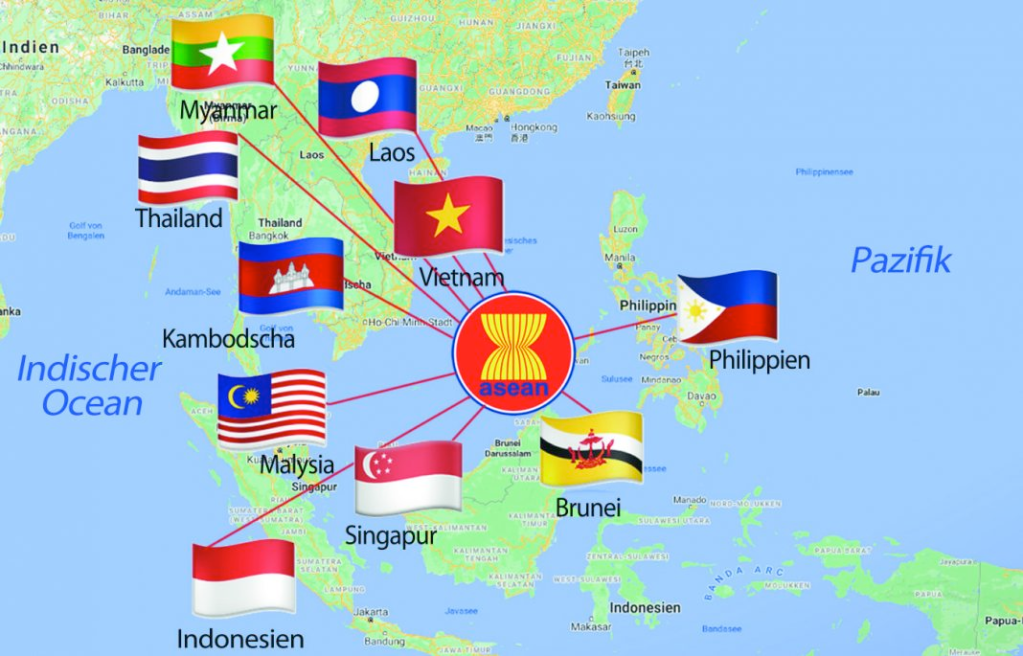
Thanks to its favorable geographical location between the key maritime lanes connecting the Indian and Pacific Oceans, the Association of Southeast Asian Nations (ASEAN) is a key strategic pillar of the Indo-Pacific regional architecture. With a population of more than 680 million people and a total GDP of about US$3.6 trillion ASEAN is considered the most dynamic and fastest growing region in the world.
In the context of competition among countries, ASEAN is trying to maintain a balanced and non-aligned „center“ role, avoiding being caught up in conflicts of interests of factions. Mechanisms such as the ASEAN Regional Forum (ARF), the East Asia Summit (EAS), and the Treaty of Amity and Cooperation (TAC) have become important tools for ASEAN to promote dialogue, cooperation, and dispute resolution.
However, ASEAN also faces many other internal challenges: differences in the political system, level of development, national interests, and dependence on China, all of which make it difficult to reach consensus within the bloc on sensitive issues. especially the South China Sea. Some countries such as Vietnam, the Philippines, and Indonesia advocate resolutely protecting sovereignty under international law, while others are cautious or biased towards Beijing.
However, ASEAN still plays an important role among the great powers, and at the same time, aims to become a center of growth, stability and innovation. In the near future, ASEAN will continue to play a soft regulatory role, promote multilateral economic and security cooperation, and in the long run, hope to make a significant contribution to an open, transparent regional structure that respects international law.
Conclusion
The Indo-Pacific region is emerging as the geo-strategic center of the 21st century, where global interests in economics, security, energy and technology intersect. The shift of power from West to East, along with the rise of China, India, and middle powers such as Japan, Australia, South Korea, and ASEAN, is reshaping the regional order in the direction of multipolarity and flexible competition.
In this dynamic context, no country can hold absolute superiority. The United States remains a traditional center of power, but its relative power is declining; while China continues to expand its influence but faces suspicion and counterbalance from other countries. Japan, India, Australia and the EU play the role of „soft balance“, helping to maintain relative stability. ASEAN, with its central role in helping to regulate competition and promote constructive dialogue in the region.
The future of the Indo-Pacific will depend on the ability of nations to maintain a balance between competition and cooperation, respect international law, protect freedom of navigation, and promote sustainable, inclusive development.
If multilateral mechanisms such as the QUAD, AUKUS, ASEAN and the EU continue to coordinate flexibly, respect each other and work towards common interests, the region can become an open, stable and prosperous space for cooperation, contributing to shaping the new world order in the 21st century.
 KIM THEM DO