Kim Them Do
Latest Developments
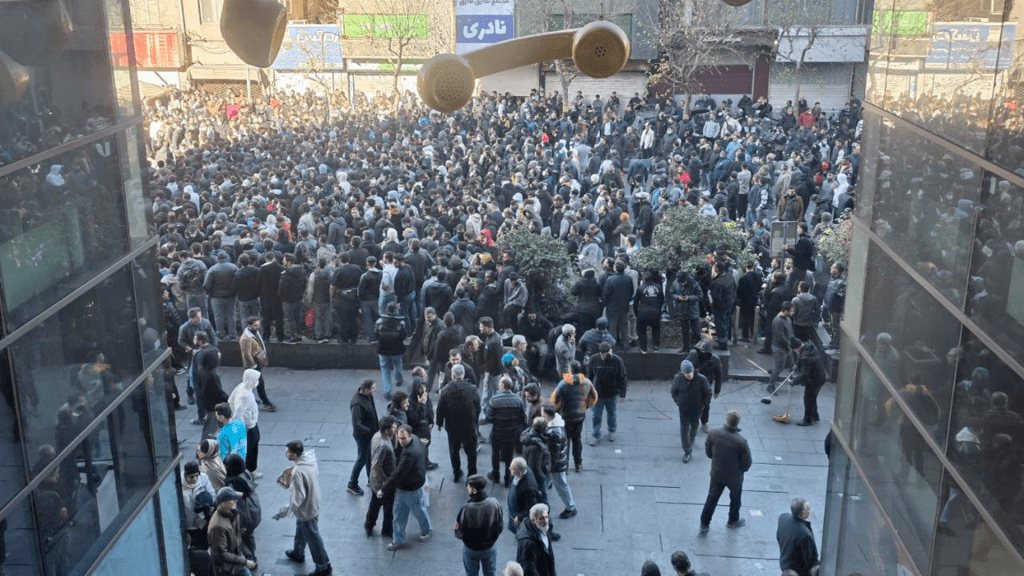
Anti-government protests are spreading across Iran. The ruling clerical establishment has responded harshly, arresting large numbers of demonstrators and blocking most internet communication channels. As international pressure mounts, many observers are questioning whether Iran’s leadership can maintain control and preserve stability.
The unrest began with protests by traders in Tehran. Within a short period, however, demonstrations expanded nationwide and intensified. The Iranian state has escalated its response, deploying the full force of its security apparatus. According to the Oslo-based human rights organization Iran Human Rights (IHRNGO), the death toll may have reached 648, with more than 2,000 people arrested. Some U.S.-based monitoring groups estimate that casualties could exceed 2,000, though these figures cannot be independently verified. Human rights activists at HRANA note that the ongoing internet shutdown makes it difficult to assess the scale of the protests or the number of participants.
Pressure on the Iranian regime is rising both domestically and internationally. Media reports indicate that the United States has urged its citizens in Iran to leave the country as soon as possible, although no concrete support measures have been announced. There is also speculation that the United States and Israel may be quietly discussing the possibility of military action. Meanwhile, Germany, France, and the United Kingdom have called on Iran to end the violence and have summoned Iranian ambassadors to demand clarification. Inside Iran, some protesters are calling for the return of the Shah’s Crown Prince, who was overthrown during the 1979 Islamic Revolution.
This wave of unrest is considered the largest since the 2022–2023 “Women, Life, Freedom” movement, which erupted after the death of Jina Mahsa Amini, a Kurdish Iranian woman who died in police custody after allegedly violating hijab regulations.
Various Causes
The primary driver of the current protests is Iran’s severe economic crisis. In late December 2025, around 100 traders in Tehran demonstrated as the Iranian rial continued to depreciate and inflation reached record highs. Many reported that it had become impossible to calculate costs or set prices. These economic pressures affect nearly the entire population, as wages have failed to keep pace with the collapsing currency.
From Tehran, the protests quickly spread across the country. Rural communities, the increasingly impoverished middle class, and dissident students joined the demonstrations, calling for an end to authoritarian rule. Chants such as “Death to the dictator!”, directed at Supreme Leader Ali Khamenei, were reported in multiple cities.
Estimates suggest that approximately 45 percent of Iranians live below the poverty line, while up to 90 percent face some degree of economic hardship. This is despite Iran being one of the world’s most resource-rich countries, with vast oil and gas reserves. Critics argue that the political leadership prioritizes maintaining power and pursuing ideological objectives over improving living conditions.
Public anger appears particularly intense this time. Many Iranians feel they lack prospects: political freedom, basic rights, and economic security all seem out of reach. Essential goods are increasingly unaffordable, poverty is spreading, and young people see little hope for the future. Fears of a new war—especially following last year’s Israeli attack—have heightened the sense of crisis. Ethnic minority communities, long subjected to state repression, have also joined the protests in significant numbers.
Brutal Reaction
The Iranian leadership is responding with extreme brutality, deploying tear gas, armored vehicles, and live ammunition to suppress the protests. Authorities have accused demonstrators of acting as “hostile forces against God.” The label “enemies of God” is deliberately vague and expansive, allowing the state to apply it to virtually anyone who takes to the streets. Under Iran’s Islamic legal system, this charge can carry the death penalty, making it one of the most dangerous accusations protesters can face.
Compared with the protests three years ago, the current wave of unrest is widely viewed as a more serious and immediate threat to national stability.
The nationwide internet shutdown has further heightened the risks. Casualties and property damage cannot be independently verified, creating an environment of uncertainty and fear. Although satellite internet services such as Starlink can provide access to information, their use is illegal and may expose individuals to severe legal consequences.
From Self-Criticism to Threats
In a televised address, President Massoud Peseshkian urged citizens to engage in dialogue in a spirit of responsibility and goodwill. He acknowledged that society cannot be persuaded—or pacified—through force alone. In a rare moment of self-criticism, he stated: “From a Muslim point of view, we will have to go to hell if we don’t solve the livelihood problem of the people.”
Despite this conciliatory rhetoric, the authorities simultaneously appear to be pursuing a strategy of intimidation and division. Police and judicial officials have repeatedly labeled demonstrators as “rebels” and “rioters.” Supreme Court Chief Justice Gholam-Hossein Mohseni Ejei has threatened rapid trials and emphasized that no leniency will be shown.
Supreme Leader Ali Khamenei has taken an even harder line, declaring that dialogue with “rebels” is pointless and insisting they would be “put in their right place.” While the government has announced limited economic reforms and modest financial assistance for disadvantaged groups, it has made clear that no fundamental political change will be considered under any circumstances.
Will the Regime Survive?
Since the Islamic Revolution of 1979, Iran’s clerical leadership has maintained power through the institution of the Supreme Leader—a position held by Ayatollah Ali Khamenei since 1989. The system relies heavily on coercion and on the loyalty of the Islamic Revolutionary Guard Corps, the country’s most powerful military and political force.
Will the protests succeed this time? The current uprising is the fourth major wave of unrest in just eight years. Notably, the intervals between protests are shrinking, while participation has broadened significantly, encompassing workers, students, the middle class, and ethnic minority communities.
Beyond domestic challenges, the leadership is also facing mounting external pressure and has been significantly weakened since the twelve-day conflict with Israel. In June 2025, Israel—supported by the United States—launched airstrikes against numerous Iranian targets, including nuclear, military, and civilian facilities. Several senior commanders from the Revolutionary Guards and the regular army were killed, and critical infrastructure sustained heavy damage. Iran responded by firing ballistic missiles at Israel. At the time, Iranian society briefly united in the face of an external threat. Whether a similar “rally around the flag” effect will occur now remains uncertain.
Speculation is growing about possible U.S.–Israeli discussions concerning a new military operation. However, the unpredictability of U.S. President Donald Trump makes future developments especially difficult to anticipate.
A new and noteworthy element of the current movement is the re-emergence of Reza Pahlavi, the son of Iran’s last Shah. He has publicly called on Iranians to join the protests, and his messages have been shared millions of times on social media. For some, Pahlavi represents a potential symbol of national unity. Yet his political agenda—and the forces that might rally behind him—remain deeply contested within Iranian society.
Despite the growing momentum, it is still too early to draw firm conclusions about Iran’s democratic future. Even a collapse of the current system or the departure of Ali Khamenei would not automatically lead to democracy. Many analysts warn that a military-dominated government is a plausible alternative. There is also no guarantee that such a transition would improve the lives of ordinary Iranians.
 KIM THEM DO