Kim Them Do
Ảnh: IMAGO / Newscom / AdMedia / IMAGO / CNP / AdMedia
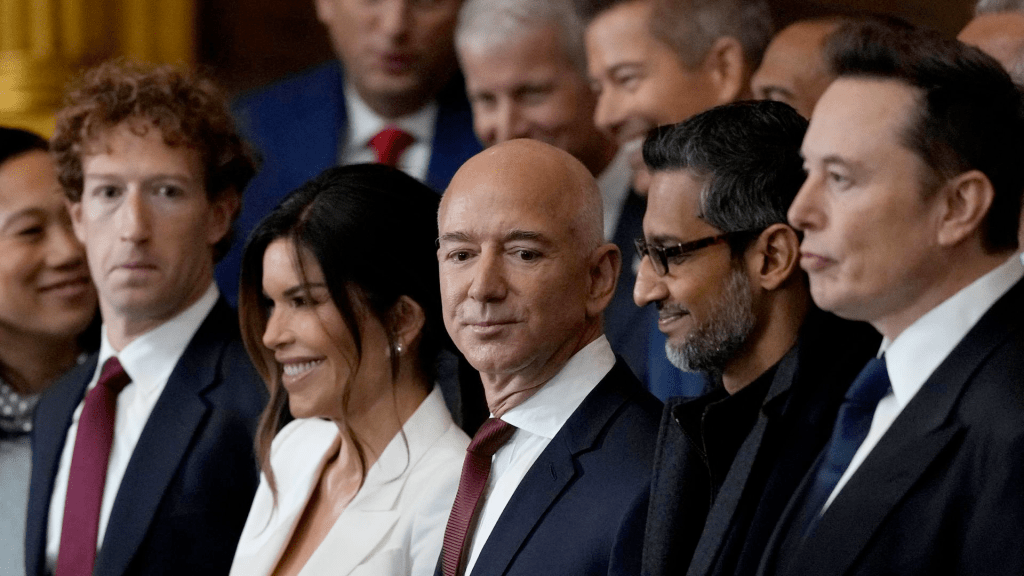
Since Donald Trump’s re – election as president, Silicon Valley’s big – tech founders and investors – including billionaires such as Elon Musk, Jeff Bezos, and Mark Zuckerberg have been seen as key influencers of the new administration. They appeared at Trump’s inauguration and quickly took on significant roles in shaping the „Make America Great Again“ agenda.
Driven by a strong belief in the transformative power of modern technology, these leaders argue that innovation can thrive best within a free market economy. They advocate for the unrestrained development of capitalism and technology as tools capable of solving major social and national challenges. Many big – tech pioneers envision themselves taking a leadership role in dismantling the complex administrative machinery of the welfare state – believing that reducing bureaucracy and unleashing innovation are the twin pillars of accelerating societal progress.
However, the close relationship between these big – tech billionaires and Trump has led to serious consequences, including the disruption of several public institutions and widespread layoffs in the federal bureaucracy. In addition to Elon Musk, Jeff Bezos, and Mark Zuckerberg, there are other, lesser – known figures who are quietly aligning themselves with Trump’s bold policy vision. Who are they? What are their goals? And how are they navigating this shifting landscape of political power?
J.D. Vance: A Key Figure at the White House
Vice President J.D. Vance – a relatively new face in American politics — has emerged as a central figure linking Silicon Valley and the Trump administration. Bold ideas from the tech world are increasingly finding a platform in him as he helps translate them into policy.
Before entering the White House, Vance served as a U.S. Senator from Ohio. He rose to prominence in 2016 with Hillbilly Elegy, a memoir steeped in conservative populism and reflections on rural American life. While once skeptical of Trump and the broader state of modern democracy, Vance’s political trajectory changed thanks in part to support from tech investor Peter Thiel. With Thiel’s backing, Vance launched a successful campaign and began building connections with Trump’s inner circle. It’s no surprise that he has referred to Thiel as a „close friend.“
As Vice President, Vance has acted as a loyal aide to Trump and a public voice in key policy discussions. In working with Silicon Valley investors to shape new economic policies, Vance has emphasized the need to „reconcile“ the interests of the state with those of tech businesses. He supports tax cuts, deregulation, minimal government interference, and increased investment in innovation.
Vance has been particularly inspired by Marc Andreessen’s “Techno-Optimist Manifesto” and has also shown sympathy toward the ideas of Curtis Yarvin – an increasingly influential thinker in the tech world since 2021.
Curtis Yarvin: The Thinker in the Shadows
Although he holds no official position, Curtis Yarvin wields considerable influence within startup circles and the pro-Trump tech sphere. He is the creator of the blog Unqualified Reservations, which promotes unconventional political ideas and is frequently cited by figures like Peter Thiel and Balaji Srinivasan. Yarvin’s influence extends beyond Silicon Valley and reaches advisers within the Trump administration, many of whom regularly read his Substack newsletter.
Yarvin is best known for his doctrine of “Neocameralism” – a distinctive political philosophy proposing that governments should operate like corporations, with the head of state acting as a CEO-king. According to Yarvin, monarchies – not democracies – are the most efficient form of governance. In his vision, the United States would cease to be a republic and instead transform into a high – performance administrative state, managed like a business enterprise.
Elon Musk and DOGE: When Technology Becomes a Tool to Reform Government
Billionaire Elon Musk, one of the most controversial figures in American public life, embodies the blurred line between tech entrepreneurship and political power. His relationship with Donald Trump has fluctuated over the years – from serving as an advisor on the Business Council, to resigning after the U.S. withdrew from the Paris Agreement in 2017, to resurfacing in 2022 with his acquisition of Twitter. Musk’s decision to reinstate Trump’s account on the platform – now rebranded as X – was not only a political statement but also a move that helped Trump regain public visibility following the fallout from January 6, 2021.
Musk’s political involvement reached its peak when he was appointed head of the newly established Department of Government Efficiency (DOGE), created by executive order on January 20, 2025. Tasked with “streamlining the state apparatus,” DOGE initiated sweeping layoffs of civil servants, slashed budgets, and dismantled numerous public agencies – all under the banner of “increasing efficiency and reducing waste.” However, beneath its technocratic façade, many critics view DOGE as an effort to undermine long – standing democratic institutions.
After his 130 – day term, Musk handed over leadership of DOGE to Amy Gleason and Russell Vought, the latter having served as Director of the Office of Management and Budget under Trump. The department has since pivoted to a targeted mission: cutting federal administrative regulations by 50%. While largely symbolic, the goal raises concerns about institutional stability and legal safeguards.
Although Musk no longer holds an official government role, his political influence remains significant. His actions reflect a pragmatic – rather than ideological – strategy: he publicly criticized Trump’s budget bill, called for the release of the Epstein files, yet quietly donated tens of millions to pro-Trump super PACs. His short – lived initiative to create the “America Party” quickly faded, reinforcing the idea that Musk’s real objective is to sustain personal political leverage, especially with the 2026 midterm elections approaching.
Despite his complex positioning, both Trump and Vice President J.D. Vance have continued to describe Musk as a “close friend” and “informal adviser.” At the same time, Musk has been pulled back by mounting challenges at Tesla, his flagship company, limiting his direct involvement in public administration. Nevertheless, his influence within the Trump administration remains substantial, even without an official cabinet post.
Marc Andreessen and the “2023 Manifesto Table”: Technology as Political Ideology
Marc Andreessen, veteran investor and strategic thinker in Silicon Valley, has emerged as a key bridge between the tech sector and the Trump administration. Initially quiet during Trump’s first term, Andreessen began making regular appearances at Mar-a-Lago in 2023, assisting with staff selection and transition planning. His most influential contribution, however, is the Techno-Optimist Manifesto – widely regarded within tech circles as a philosophical blueprint for the new era.
In the manifesto, Andreessen writes: “Politics is an obstacle. Technology is the solution. With enough technique, no problem is unsolvable.” His vision is not merely aspirational — it is revolutionary. Technology, in his view, should not just assist governance but replace its traditional mechanisms. He advocates for a future of “inclusive capitalism,” where legal, governmental, and civil constraints are cast aside in favor of unrestrained innovation and speed.
German philosopher Anna – Verena Nosthoff, co – director of the Critical Data Lab, critiqued Andreessen’s manifesto as lacking philosophical rigor and systemic depth. Still, she acknowledged its appeal to younger technologists, describing it as a form of “technologized ideology” — a simplified worldview offering a clear call to action: Accelerate progress, don’t hesitate.
Andreessen remains a significant player in the new power landscape – a financial backer, connector, and ideological catalyst for figures like Peter Thiel, J.D. Vance, and even Curtis Yarvin. Though less radical than Yarvin, Andreessen shares his goal of shrinking the state, expanding corporate influence, and turning technology into a legislative force.
The New Power Network: From Post – Democracy to Technological Authoritarianism
The pressing question now is whether the emerging alliance between big – tech billionaires and the Trump administration is temporary or the foundation of a lasting power structure. The answer appears to be affirmative – but not in the form of a secret cabal. Rather, it functions as a loose, self – reinforcing coalition, built on mutual interests. While lacking a formal political platform, its members share a core belief: representative democracy is obsolete. In its place, they envision a post -democratic model where authority stems from capital, technological prowess, and the capacity to redesign society from the top down.
This evolving network blends intellectual influence, financial capital, technological control, and political power. Peter Thiel serves as a strategic center of gravity; Curtis Yarvin supplies the ideological edge; J.D. Vance operates as a political conduit; Andreessen funds and frames the vision — while firms like Palantir and SpaceX act as the operational arms. This is the „techno-right“: decentralized, not always aligned, but unified in its ambitions.
What connects them is a shared conviction: technology is not just a means of production – it is a means of rule. They foresee a world where governments run like corporations, laws are coded into algorithms, and power is wielded by startup founders rather than democratically elected representatives. It’s a vision where science fiction becomes political reality – a future in which tech companies become not just economic, but political, social, and cultural rulers.
Implications for American Democracy: When Votes Face Off Against Algorithms
American democracy is facing a crisis – not from its traditional institutions, but from the growing influence of private tech platforms and the billionaires who control them. In this new landscape, the pressing question is whether American voters still hold the power to determine the nation’s destiny.
The most immediate danger lies in the concentration of informational power in the hands of a few unelected individuals who now dominate the public sphere: Elon Musk (X, formerly Twitter), Mark Zuckerberg (Facebook/Instagram), and Jeff Bezos (Amazon and The Washington Post). Their control over platforms, algorithms, and the flow of information effectively positions them as gatekeepers of modern discourse—acting as de facto censors of democracy.
Bezos, one of Donald Trump’s most vocal critics, owns The Washington Post, a publication known for its consistent criticism of Trump’s policies and leadership style. Trump, in turn, has repeatedly targeted Bezos – accusing Amazon of tax evasion, labeling the Post as “fake news,” and even threatening federal investigations. Despite this rivalry, Bezos continues to wield enormous influence over public opinion through mainstream media.
Mark Zuckerberg, meanwhile, was accused of enabling misinformation during the 2016 election – indirectly contributing to Trump’s victory. Since then, he’s been caught in a political crossfire: attacked by progressives for inaction, and by conservatives for perceived censorship of right-wing voices. In response, Zuckerberg adopted a posture of technological neutrality, avoiding deep intervention while also failing to curb the growing chaos on social media platforms.
As a result, today’s media platforms are no longer neutral arenas – they have become political battlegrounds. Algorithms, targeted ads, and artificial intelligence now shape not only consumer habits, but also public consciousness and voter behavior. The electoral manipulations seen in 2016 and 2020 may soon resurface – on a larger and more sophisticated scale.
Shifting to the Far Right: From Critique to Control
Within the tech world, a significant ideological shift is underway: a turn toward the far right, framed as an effort to “restore order” and “rescue democracy from dysfunction.” A loosely connected group – Elon Musk, Marc Andreessen, Peter Thiel, and Curtis Yarvin – has begun to operate more like a private ideological network, exchanging increasingly radical, anti – democratic ideas in closed channels like Signal and encrypted platforms.
Since the COVID-19 pandemic, Marc Andreessen has hosted dozens of off – the -record meetings on secure messaging platforms, discussing the collapse of institutional trust and the notion that “technology is politics.” All messages from these sessions are reportedly set to auto-delete within 30 seconds – adding both a layer of security and a mystique of secrecy reminiscent of an “elite digital cabal.”
Elon Musk, once a centrist with Democratic leanings, has now positioned himself as a vocal opponent of “woke culture,” denouncing multiculturalism and advocating for absolute free speech – a position that, in practice, often involves tolerating disinformation. His transformation signals more than personal disillusionment – it reflects a broader redefinition of governance, where democracy based on law is gradually replaced by rule by technocratic elites.
Conclusion: American Democracy Faces a New Kind of Test
In the age of digital hyper-connectivity, the threats to American democracy no longer come solely from foreign authoritarian regimes – they now emerge from within, through the privatization of information and influence. Figures like Musk, Bezos, and Zuckerberg hold no official office, yet possess unprecedented power to shape political reality, from public discourse to voter perception.
Their influence is informal and uneven – but increasingly decisive. The real danger lies in the question: Is Trump still in control of this power dynamic, or is he merely a figurehead in the hands of those who control the platforms?
These tech magnates aren’t forming a traditional political party. Instead, they share a common worldview – a fusion of futurism, libertarianism, and technocracy – where capital and algorithms dictate outcomes, and where democracy is seen as outdated and inefficient. What is quietly emerging is a form of “technocratic authoritarianism”, where legal institutions struggle to keep pace with the speed of algorithmic governance and AI – driven reform.
Meanwhile, the 77 million Americans who voted to bring Trump back to power in 2024 may now feel increasingly sidelined. Even among Trump’s most fervent MAGA supporters, a new doubt is emerging: Does Trump still represent us – or has he become a tool for a new elite class of tech rulers?
There is still hope. The 2026 midterm elections offer an opportunity for the electorate to reassert itself. But the question remains: Can the vote still carry real weight in an environment where public opinion is algorithmically shaped, where the marketplace of ideas is privately owned, and where policy decisions are guided by financial spreadsheets rather than citizen will?
The answer is not yet clear. But one thing is certain: American democracy is entering an era of trial by fire unlike anything seen in modern history.
 KIM THEM DO