The Power Game Between China and the United Stat
Kim Them Do
Background
For decades, Taiwan has lived under the constant threat of annexation by the People’s Republic of China (PRC). Although Taiwan is a vibrant democracy with leaders chosen through free and direct elections, Beijing continues to insist that the island is an inseparable part of its territory—even though Taiwan has never been governed by the PRC since its establishment in 1949.
Whenever Chinese officials reiterate the goal of “national reunification,” they leave open the possibility of using force. China’s military drills, grey-zone tactics, and coercive measures have intensified in recent years, placing growing pressure on Taiwan. More than ever, Taiwan depends heavily on the security commitment and military assistance of the United States.
However, since Donald Trump’s return to the U.S. presidency, public confidence in Washington has weakened in Taiwan. Notably, the Trump administration has not approved any new arms packages for Taipei. Against the backdrop of rising Chinese pressure, concerns are mounting in Taiwan that the United States and its allies might one day “trade away” Taiwan in pursuit of economic or strategic deals with Beijing.
Taiwan in China’s Sights
China’s claims over Taiwan are rooted in a combination of ideological narratives and geopolitical ambitions. In Beijing’s political imagination, “national reunification” is portrayed as a historic mission and a central element of the “Chinese Dream.”
Taiwan also occupies a highly strategic location. Control of the island would give China greater military reach across the South China Sea and deeper influence throughout the Indo-Pacific. The Taiwan Strait—roughly 180 kilometers wide—is a critical maritime corridor through which thousands of commercial vessels pass each day. Beijing even asserts that the strait constitutes part of its internal waters, a position rejected by the United States and many other countries.
Taiwan Without Official Sovereignty
Officially, Taiwan is known as the Republic of China (ROC), but only a handful of countries formally recognize it as a sovereign state. Nonetheless, Taiwan operates as a de facto independent nation, with its own democratic institutions, military, currency, and foreign economic relationships. It maintains strong trade ties with the United States, Europe, and many Asian partners.
Most people in Taiwan oppose unification with China, especially younger generations who fear that Taiwan would lose its freedoms—as Hong Kong did under Beijing’s tightening control.
The ROC was established on the Chinese mainland in 1912. Taiwan, then a Japanese colony, was placed under ROC administration in 1945 after World War II. Following the Chinese Civil War, Chiang Kai-shek’s Nationalist government retreated to Taiwan in 1949, while Mao Zedong founded the People’s Republic of China (PRC) in Beijing.
Since then, two separate political entities—both claiming to represent “China”—have existed. Taiwan held China’s seat at the United Nations until 1971, when it was transferred to the PRC. Under the “One China” policy at the UN, Beijing is recognized as representing all of China, including Taiwan.
Economy of Taiwan
From smartphones to defense technologies, Taiwan is a global leader in several high-tech sectors—most notably the semiconductor industry. Taiwan Semiconductor Manufacturing Company (TSMC), the island’s technological powerhouse produces more than half of the world’s chips. For advanced, high-performance semiconductors used in artificial intelligence (AI), data centers, and cutting-edge electronics, Taiwan’s share rises to nearly 90%.
The world’s reliance on Taiwanese chip manufacturing became dramatically clear during the COVID-19 pandemic, when supply chains were severely disrupted. Despite U.S. and European efforts to diversify production and build domestic fabrication plants, Taiwan’s central role in the global semiconductor ecosystem remains, for now, irreplaceable.
China’s “Sashimi Tactics”
As Chinese military exercises increasingly approach Taiwanese airspace and waters, Beijing’s posture has grown more assertive and threatening. President Xi Jinping has repeatedly emphasized that the use of force remains an option for achieving “national reunification.”
Alongside military pressure, Taiwan faces a strategy often described as “sashimi tactics”—a gradual, incremental encroachment designed to weaken Taiwan’s resilience and international status. These tactics include coordinated disinformation campaigns, political interference, and psychological operations aimed at undermining public trust and eroding Taiwan’s diplomatic support.
In addition to extensive cyberattacks, China has intensified its use of lawfare, employing legal and quasi-legal measures to delegitimize Taiwan in international forums. Beijing promotes narratives portraying Taiwan as lacking any sovereign standing under the U.N. system, aiming to isolate the island diplomatically and increase its dependence on a shrinking number of supportive partners.
China has also begun tying economic engagement and market access to political concessions. Countries or companies seeking cooperation in critical sectors—such as rare earths, pharmaceuticals, and high-tech components—are increasingly expected to adopt a “friendly” posture toward Beijing and mute their criticism on sensitive issues, especially Taiwan. Diplomacy, trade, and political messaging are being tightly coordinated to reinforce this pressure.
Germany’s Weakness
Germany’s relationship with China highlights how Beijing leverages its economic power to shape political behavior. In response to Beijing’s growing assertiveness, German Foreign Minister Johann Wadephul canceled a planned visit after Chinese officials signaled, they could only arrange a brief meeting with their foreign minister, a move widely interpreted as a diplomatic snub.
China’s posture suggests it sees Germany as indecisive and internally divided, prompting Beijing to apply maximum pressure. German industries have been hit hard by China’s export restrictions on rare earths, microchips, and other strategic materials. Beijing expects Wadephul to soften his public criticism of China’s Taiwan policy as a condition for improving bilateral relations.
While Wadephul postponed his trip, Finance Minister Lars Klingbeil sought to reestablish dialogue. During discussions in Beijing with Vice Premier He Lifeng, China signaled a willingness to address some of Germany’s concerns about export controls and supply-chain bottlenecks.
Klingbeil stressed that economic competition must take place on fair terms, which includes reliable access to critical raw materials and reductions in Chinese industrial overcapacity. China, the world’s dominant supplier of rare earths essential for advanced manufacturing and defense technologies, has tightened its export rules. German companies now face lengthy approval processes and often receive only limited shipments.
Germany’s imbalance with China continues to widen: Chinese imports from Germany have dropped, while Chinese exports—particularly in machinery, electronics, solar panels, and electric vehicles—have surged. This has contributed to Germany’s record trade deficit with China.
Amid tensions between Beijing and Brussels, China hopes Berlin will use its influence to moderate the EU’s tariffs on Chinese electric vehicles. In retaliation for EU measures, Beijing has launched anti-dumping investigations into select European products, deepening the ongoing trade confrontation.
Threats Between the United States and China
A development during U.S. President Donald Trump’s recent trip to Asia has sparked fresh concern in Taiwan. On October 30, 2025, in Busan, President Trump and Chinese President Xi Jinping reached an agreement to reduce tariffs and ease restrictions on rare earth exports. Trump hailed the deal as a “great success,” yet notably, the Taiwan issue was absent from the agenda.
This omission has deepened fears that, in the ongoing U.S.–China trade rivalry, President Trump may scale back support for Taiwan in exchange for short-term economic gains. Several reports even suggest that Xi Jinping privately promised not to attack Taiwan during Trump’s current term. Meanwhile, the White House has not approved any new arms contracts for Taiwan and has rejected more than $400 million in military aid—further fueling doubt in Taipei about the reliability of U.S. commitments.
F-16 Fighter Jets and Warships
For decades, the United States has been Taiwan’s primary security guarantor, supplying F-16 fighter jets, naval vessels, and a range of other defensive systems. However, China’s continual expansion of its military capabilities in the South China Sea and the broader Indo-Pacific has become a significant strategic challenge for Washington.
Recently, U.S. Defense Secretary Pete Hegseth warned that China is showing “clear and credible indications” of actively preparing for a potential invasion of Taiwan by 2027. Beijing responded sharply, accusing him of harboring a “Cold War mentality” and of maligning China’s intentions.
Nevertheless, one reality remains: Taiwan’s security depends heavily on the evolving relationship between the world’s two most powerful nations. Whether that relationship stabilizes or deteriorates will shape not only the island’s future, but also the geopolitical balance of the entire Indo-Pacific in the years ahead.
Japan’s Role
Japan’s increasingly assertive posture under Prime Minister Sanae Takaichi is reshaping Taiwan’s strategic outlook. For Taipei, Japan is not only a major economic partner but also its closest democratic neighbor, separated by barely 110 kilometers of water.
Tokyo’s recent statements – explicitly describing a Chinese attack on Taiwan as a “survival-threatening situation” for Japan – signal a historic departure from strategic ambiguity. This shift strengthens deterrence, suggesting that any Chinese military operation would risk drawing in Japan and, by extension, the full force of the U.S.–Japan alliance.
At the same time, Taiwan understands that Takaichi leads a minority government and faces domestic constraints; Japanese intervention in a crisis is possible but not guaranteed. As a result, Taiwan is recalibrating its defense planning to deepen security coordination with Tokyo while also accelerating its own asymmetric-defense programs.
For Taipei, Japan’s new stance is both a strategic opportunity and a strategic uncertainty – a potential shield, yet one dependent on Japan’s political cohesion and willingness to act when pressure peaks.
Conclusion
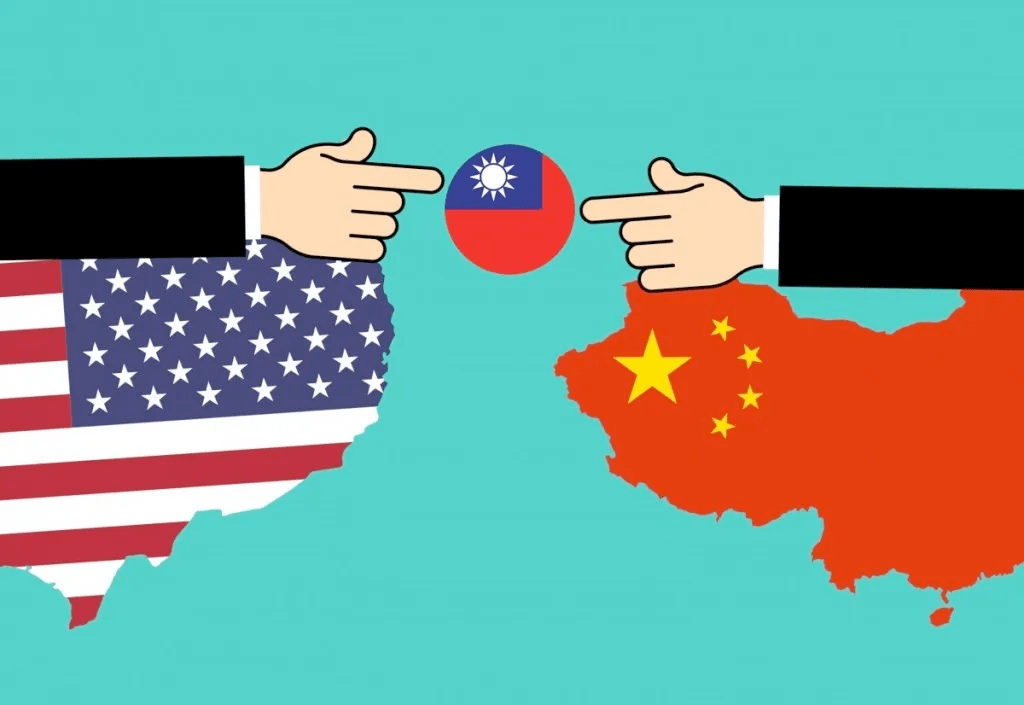
Taiwan has become the focal point of great-power competition between the United States and China. Beijing insists on “reunification” at virtually any cost, while Washington must navigate a complex mix of strategic, economic, and moral responsibilities. As deals between the two powers shift rapidly, Taiwan risks being reduced to a bargaining chip on the geopolitical chessboard—echoing the tragic precedent of Vietnam in 1975, when the aspirations of a smaller nation were subordinated to superpower interests.
Taiwan’s fate is therefore more than a regional issue. It is a critical test of America’s commitment to the Indo-Pacific and a measure of the resilience of the rules-based international order. If the island’s survival and democratic freedoms are traded for commercial gains, the world may again witness the painful lesson history has taught before: when great powers prioritize short-term advantage, the peace, democracy, and justice of smaller nations are often the first to be sacrificed.
 KIM THEM DO